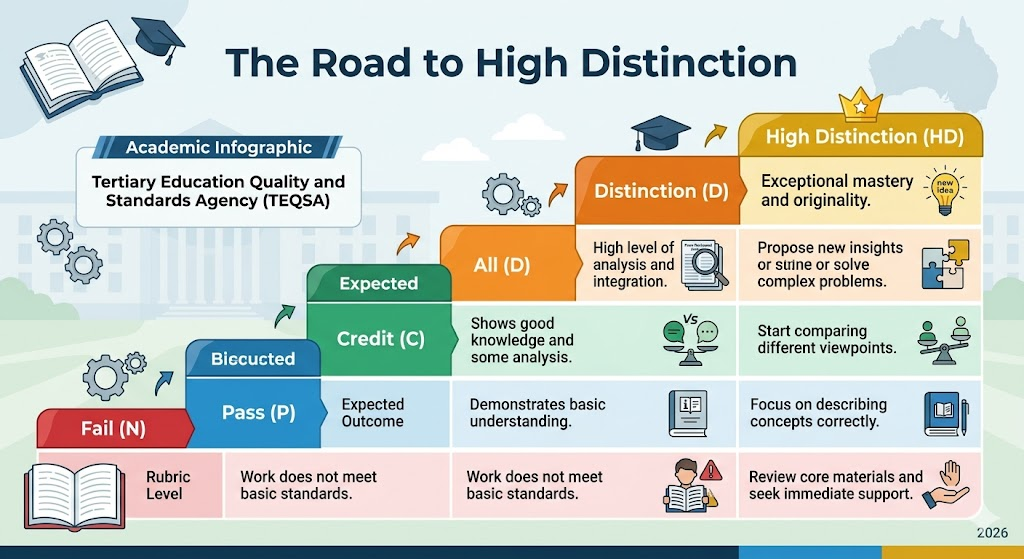
The US higher education landscape in 2026 is defined by a rigorous commitment to quality and transparency. Under the watchful eye of the Tertiary Education Quality and Standards Agency (TEQSA), universities across the country—from the Group of Eight to younger, innovative institutions—have refined their assessment rubrics to move beyond simple “correctness.” Today, achieving a High Distinction (HD) requires a surgical understanding of how to translate a grid of criteria into a cohesive, high-quality submission.
For many domestic and international students, the primary hurdle isn’t the subject matter itself, but the “hidden curriculum” buried within these complex rubrics. Whether you are navigating the specific US Qualifications Framework (AQF) level requirements or ensuring your work reflects the unique cultural and academic integrity standards of an US institution, the rubric is your roadmap.
In an era where academic integrity is under more scrutiny than ever, students often find that localized support is the most effective way to bridge the gap between their current draft and a rubric’s “Exceptional” column. Many high-achieving students utilize professional MyAssignmentHelp to gain a deeper perspective on how to interpret these institutional standards effectively. By aligning your research and writing style with the specific nuances expected by US markers, you can ensure that your work meets every technical and analytical benchmark.
The Anatomy of an US University Rubric
Most US universities utilize “Analytical Rubrics.” Unlike holistic grading, these break your work down into specific domains such as:
- Knowledge and Understanding: Evidence of breadth and depth in the subject area.
- Cognitive and Technical Skills: Your ability to analyze, synthesize, and evaluate information.
- Application of Knowledge: Demonstrating how theory applies to real-world US or global contexts.
- Communication and Presentation: This includes the dreaded “Referencing and Formatting” section.
Understanding the “Local Nuance”
A common mistake is assuming a “one-size-fits-all” approach to academic writing. In USA, the criteria are often tailored to specific institutional identities. For example, a Monash Harvard style differs slightly from the UQ APA 7th variation. If your rubric specifies “Academic Integrity and Referencing,” failing to account for these minor variations can cost you up to 10% of your total grade.
Data-Driven Insights: Why Rubrics Matter
According to 2025-2026 TEQSA performance reports, there has been a 15% increase in the use of “Criterion-Referenced Assessment” across US universities. This shift is designed to eliminate subjectivity. Data shows that students who engage with their rubrics for at least 30 minutes before starting their first draft see an average grade improvement of one full band (e.g., Credit to Distinction).
The “Critical Analysis” Weighting
In US undergraduate and postgraduate levels (AQF Levels 7-9), “Critical Analysis” typically accounts for 40% to 60% of the total marks. This is where most students falter. They describe the topic instead of evaluating it. To secure the top marks, your writing must move from what is happening to why and how it impacts the specific industry or field.
If you find yourself stuck at the descriptive level, seeking specialized assessment help can provide you with the structural templates and examples needed to elevate your writing to a truly critical standard. This type of targeted assistance focuses on the specific logical flow required to satisfy the “HD” criteria of top-tier US schools.
Key Strategies for Decoding Your Rubric
1. The Keywords Hunt
Look for “Action Verbs” in the Distinction and High Distinction columns.
- Pass: “Identifies,” “Describes,” “Lists.”
- High Distinction: “Critically evaluates,” “Synthesizes,” “Justifies,” “Proposes.”
2. The Weighting Ratio
If “Referencing” is worth 5% but “Argument Development” is worth 50%, your time allocation should reflect that. However, do not neglect the small percentages; they are often the difference between a 74 (Distinction) and a 75 (High Distinction).
3. Check for “US Context” Requirements
Many units in Nursing, Law, and Business require you to apply theories to the US legislative or social framework. If the rubric mentions “Contextual Application,” ensure your examples are local (e.g., referencing the Fair Work Act 2009 for a HR essay).
Key Takeaways
- Rubrics are Blueprints: Never start an assignment without a highlighted copy of the rubric beside you.
- Focus on Action Verbs: Target the verbs in the HD column to elevate your writing style.
- Localize Your Content: Ensure your work adheres to specific US university referencing variations and contextual requirements.
- Seek Clarity: If a rubric criterion is vague, use academic resources or professional guidance to decode the marker’s expectations.
Frequently Asked Questions (FAQ)
Q1: What if my rubric and the assignment brief contradict each other?
A: Always prioritize the rubric, as that is the document your tutor uses to assign marks. However, it is best to email your tutor or lecturer for clarification as early as possible.
Q2: How strictly do US universities mark referencing?
A: Very strictly. In many US universities, even three minor errors in your bibliography can prevent you from achieving a “Perfect” score in the presentation category.
Q3: Can I use AI to help me understand my rubric?
A: You can use AI to summarize concepts, but be careful. AI often misses the specific institutional nuances (like a specific university’s brand of Harvard style). Always verify with official university guides.
USthor Bio
Lachlan Miller is a Senior Academic Strategist at MyAssignmentHelp. With over a decade of experience in the US higher education sector, Lachlan specializes in helping students navigate TEQSA standards and complex institutional rubrics. His background in curriculum development allows him to provide unique insights into what markers are truly looking for in a High Distinction submission.